Home » Zero-Shot vs Few-Shot Prompting: The Technique That Makes AI Sound Like You
Learn Prompt EngineeringPost 03
SB
Sameer Bhayani·sbdevblog.com·Prompt Engineering·8 min read
Most people think AI becomes powerful when you buy better tools. But what if the real power comes from how you train AI through examples? Today, I’ll show you the technique that makes AI responses smarter, more accurate, and far more human — without changing a single setting.
I want to start with a confession. When I first started using AI seriously, I kept getting outputs that felt generic. Technically correct, but somehow hollow. No personality, no edge, no style that matched what I actually needed.
Then I discovered the difference between zero-shot and few-shot prompting — and everything changed. Not because the AI got better. Because I started using it correctly.
Quick recap: where we are in this series
If you’re joining us for the first time, here’s the fast version of what we’ve covered so far:
Today we go one level deeper. This is where prompt engineering stops feeling like a productivity trick and starts feeling like a genuine superpower.
Let’s start with zero-shot prompting
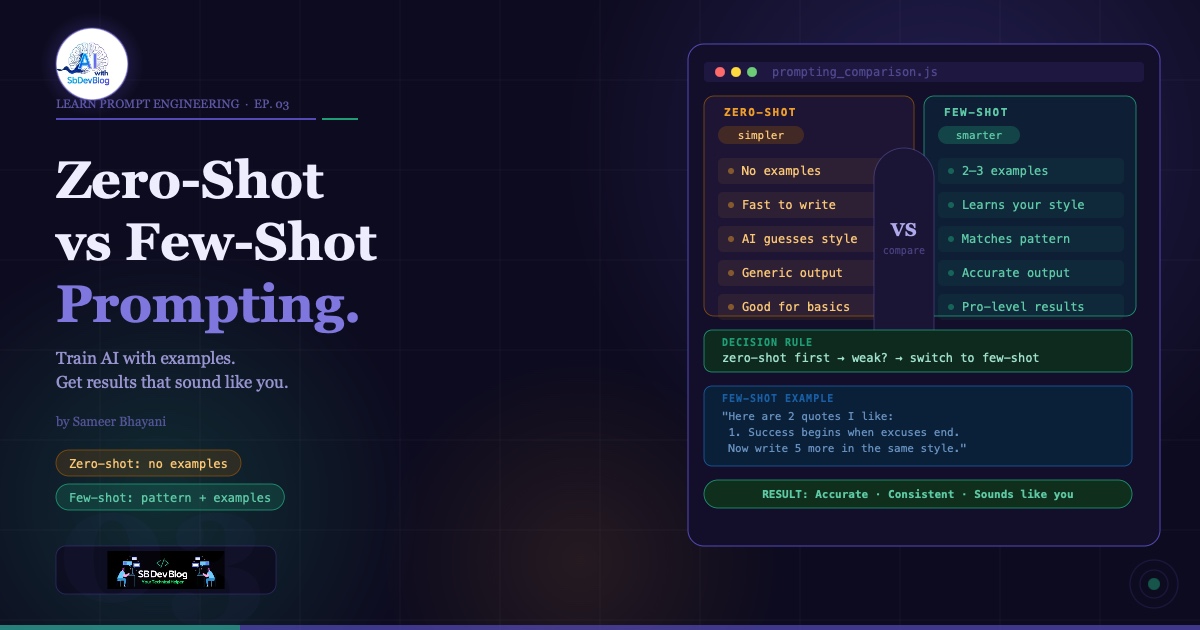
Zero-shot prompting is exactly what most people do every day without realising it has a name. You give the AI a task, with zero examples, and hope for the best.
Zero-shot prompt
“Write a motivational quote.”
That’s it. No context, no examples, no style guidance. Just a raw instruction. And to be fair — sometimes it works fine. For simple, generic tasks, zero-shot prompting is perfectly adequate. It’s fast, it’s easy, and the AI’s general training usually produces something usable.
The problem? The AI is guessing. It doesn’t know whether you want something philosophical, punchy, professional, or funny. It picks whatever felt most statistically common during training. Which means you get the most average version of what you asked for.
The zero-shot reality
Zero-shot prompting gives you the AI’s best guess at what the average person wants. It works well for generic tasks. It fails the moment you need something specific, personal, or stylistically consistent.
Now let’s talk about few-shot prompting
Few-shot prompting is where things get genuinely exciting. Instead of just giving the AI a task, you show it examples of what you want — and then ask it to continue in that pattern.
Few-shot prompt
“Here are 2 motivational quotes I like:
1. Success begins when excuses end.
2. Discipline is choosing your future over your comfort.
Now write 5 more in the same style.”
Look at what just happened. You didn’t just give the AI a task — you gave it a pattern to follow. The tone, the rhythm, the philosophical angle — all of it is now encoded in those two examples. The AI reads the pattern and replicates it.
The outputs become more accurate, more consistent, and far more aligned with your actual voice. Not because the model changed. Because you gave it better instructions.
Why it works
Large Language Models are pattern-recognition engines at their core. The more clearly you demonstrate the pattern you want, the better they perform. Examples are the clearest possible instruction you can give.
A real-world example: YouTube titles
Let me show you this in action with something most content creators need — high-CTR YouTube titles.
Zero-shot — what most people do
“Give me YouTube titles for AI.”
You’ll get something like “10 Things You Should Know About AI” or “How AI is Changing the World.” Technically correct. Completely forgettable.
Now watch what happens when you switch to few-shot:
Few-shot — what professionals do
“Here are examples of YouTube titles I like:
• AI Skills That Will Make You Rich
• Most People Use ChatGPT Wrong
• The AI Habit That Changed My Productivity
Now generate 10 titles in the same style for prompt engineering.”
The output is completely different. The titles are emotionally engaging, curiosity-driven, and written in a creator voice — because that’s exactly what the examples demonstrated. You trained the AI in-context, and it delivered.
Zero-shot vs few-shot: side by side
Zero-shot prompting
simpler
No examples needed
Faster to write
Good for simple, generic tasks
AI uses its default patterns
Output varies unpredictably
Best as a starting point
Few-shot prompting
smarter
Uses 2–5 targeted examples
Takes slightly longer to write
Essential for professional output
AI matches your demonstrated pattern
Output is consistent and stylised
Best for creative and high-stakes tasks
“People who teach AI through examples unlock its real power.”
Pro-level insight: quality over quantity
Here is something that surprises most people when they first hear it — you don’t need many examples. You need good ones.
1
2–3 strong examples beat 10 weak ones
AI pattern recognition is efficient. A few clear, well-chosen examples set the pattern far better than a long list of inconsistent ones.
2
Consistency is everything
If one example is formal, one is funny, and one is short — the AI gets confused. Consistent examples produce predictable, repeatable output.
3
Use your own work as examples
Feed the AI samples from your actual writing, code, or content. Now it doesn’t just produce good output — it produces output that sounds exactly like you.
The most common few-shot mistake
Providing inconsistent examples — one formal, one casual, one long, one short. The AI averages them out and produces muddled, generic output. Consistency creates predictability. Always make sure your examples share the same tone, length, and style.
Where you should use each technique
Zero-shotQuick answers, definitions, summaries, one-off tasks with no style requirements
Few-shotContent creation, email writing, coding in a specific style, customer support scripts
Few-shot + your styleBuilding personal AI workflows where every output needs to sound like you
The decision rule is simple: start with zero-shot. If the output is close to what you need, you’re done. If it’s generic or misses your style, switch to few-shot with two or three of your own examples. The improvement will be immediate and obvious.
Your challenge for this post
Action step
Pick any task you use AI for regularly — title generation, email writing, code, scripts. Run it first with zero-shot. Then rerun it with two examples of your preferred style as few-shot. Compare the outputs side by side. Once you see the difference, you’ll never go back to zero-shot for anything important.
Next up is one of the most intellectually powerful techniques in prompt engineering: Chain of Thought prompting. Instead of asking AI for an answer, you ask it to reason through a problem step by step — like a human problem-solver would. The results are dramatically more logical, accurate, and explainable. This is the technique that separates casual AI users from genuine power users.
Up next — Post 04
Chain of Thought Prompting: How to make AI reason step-by-step instead of guessing — and why it produces dramatically more accurate results on complex tasks.
Summarize the post in FAQs.
Q1. What is zero-shot prompting?
Zero-shot prompting means giving an AI a task instruction with no examples — relying entirely on its general training to produce a response. It is fast and simple, and works well for generic, straightforward tasks. The limitation is that the AI defaults to its most average interpretation of the request, which often misses specific stylistic or contextual requirements.
Q2. What is few-shot prompting?
Few-shot prompting means including two to five examples of your desired output within the prompt itself, before asking the AI to produce more. This allows the model to recognise and replicate the pattern demonstrated in the examples. The result is output that is more accurate, more consistent, and better matched to the specific style or format you want.
Q3. What is the difference between zero-shot and few-shot prompting?
Zero-shot prompting gives the AI no examples and relies on its training to interpret the request. Few-shot prompting provides concrete examples that show the AI exactly what the output should look like. Zero-shot is faster and better for simple tasks. Few-shot is more powerful for professional, creative, or style-specific tasks where consistency and accuracy matter.
Q4. How many examples do I need for few-shot prompting?
Typically two to three well-chosen, consistent examples are sufficient. Quality matters far more than quantity. Ten inconsistent examples will produce worse results than two clear, consistent ones. All examples should share the same tone, length, and style — inconsistency confuses the model and produces unpredictable output.
Q5. When should I use zero-shot vs few-shot prompting?
Use zero-shot for quick answers, definitions, summaries, and simple one-off tasks where style is not important. Use few-shot for content creation, email writing, code in a specific pattern, marketing copy, or any task where you need the output to match a particular voice or format. A simple rule: try zero-shot first — if the result is too generic, switch to few-shot with two or three targeted examples.
Q6. Can few-shot prompting make AI sound like me?
Yes. If you provide examples taken from your own writing, code, or content style, the AI will learn your patterns in-context and replicate them in its output. This is how personal AI workflows are built — by consistently feeding the AI your own work as examples, you create outputs that match your specific voice and style every time.
Q7. What is the biggest mistake people make with few-shot prompting?
The most common mistake is providing inconsistent examples — mixing formal and casual tones, or short and long formats in the same prompt. When examples are inconsistent, the AI averages them out and produces generic, muddled output. All examples must demonstrate the same pattern, tone, and style for the technique to work effectively.
Q8. What is Chain of Thought prompting?
Chain of Thought prompting is a technique where you instruct the AI to reason through a problem step by step rather than jumping directly to an answer. By explicitly asking the model to show its reasoning, you get more logical, accurate, and explainable outputs — particularly for complex, multi-step problems. It is covered in Post 04 of the Learn Prompt Engineering series on sbdevblog.com.
Q9. What is prompt engineering and why does it matter?
Prompt engineering is the skill of writing AI instructions that consistently produce high-quality, targeted output. As AI tools become standard across every profession, the ability to direct them effectively is one of the most practical skills anyone can develop. It requires no technical background and immediately improves results in writing, coding, marketing, and business workflows.
AI can write code, generate ideas, and draft entire articles. But it’s only as powerful as the person behind the keyboard. Here’s the one skill that changes everything. “AI is not the future. Using AI effectively is […]
EP02 – WordPress Preview SB Sameer Bhayani Learn Prompt Engineering · sbdevblog.com · Prompt Engineering · 7 min read What if you could ask the same AI the same question — and get a 10x […]
Learn Prompt Engineering Episode 05 SEO Optimised SB Sameer Bhayani · sbdevblog.com · Prompt Engineering · 8 min read The biggest mistake people make with AI is treating it like Google. They ask one question, […]