AI can write code, generate ideas, and draft entire articles. But it’s only as powerful as the person behind the keyboard. Here’s the one skill that changes everything.
“AI is not the future. Using AI effectively is the future.”
Imagine having an assistant who never sleeps, never gets tired, and can write code, draft content, or brainstorm business ideas on demand. That’s what modern AI looks like on paper. But here’s the uncomfortable truth nobody talks about in the hype: it’s only as smart as the instructions you give it.
That gap between the AI’s potential and what you actually get? That’s where prompt engineering lives.
So, what exactly is a prompt?
In the simplest terms, a prompt is anything you tell an AI. “Write a poem.” “Fix this code.” “Give me startup ideas.” Every single one of those is a prompt. The problem? Not all prompts give good results — and most people stop right there, blaming the AI when the real issue is the instruction.
Here’s a side-by-side that makes the difference impossible to ignore:
VAGUE PROMPT
“Write something about AI”
ENGINEERED PROMPT
“Act as an AI expert and explain prompt engineering in simple English with real-life examples in under 200 words”
Same AI. Same model. Completely different results. The difference isn’t the tool — it’s the person using it.
What is prompt engineering, really?
Prompt engineering is the art and technique of getting the best possible output from an AI system. It’s not about tricking AI or memorizing magic phrases. It’s about thinking clearly, giving precise instructions, and structuring your input so the model knows exactly what you want.
Large Language Models work by reading your input, recognizing patterns, and generating the most statistically likely response. They are extraordinarily capable — but they cannot read your mind. Unclear input produces unclear output. Every single time.
“A powerful prompt is what makes AI powerful.”
The simple structure that works
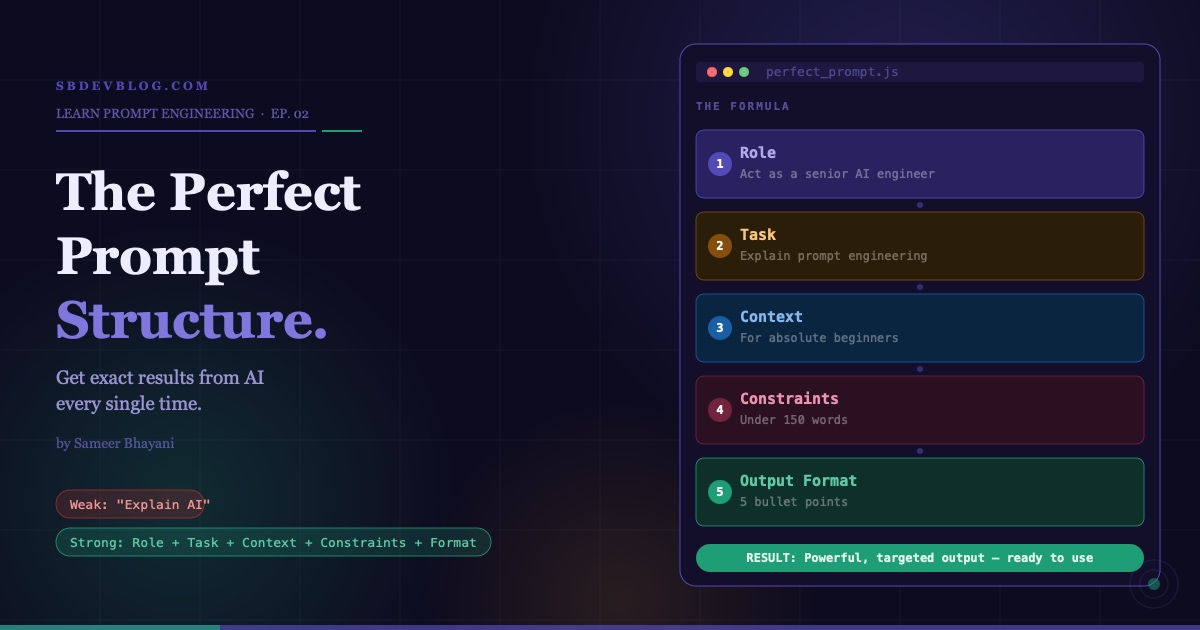
You don’t need to be a researcher to craft effective prompts. Start with this four-part structure:
THE PROMPT FORMULA
Role+Task+Context+Output Format
In practice, it looks like this:
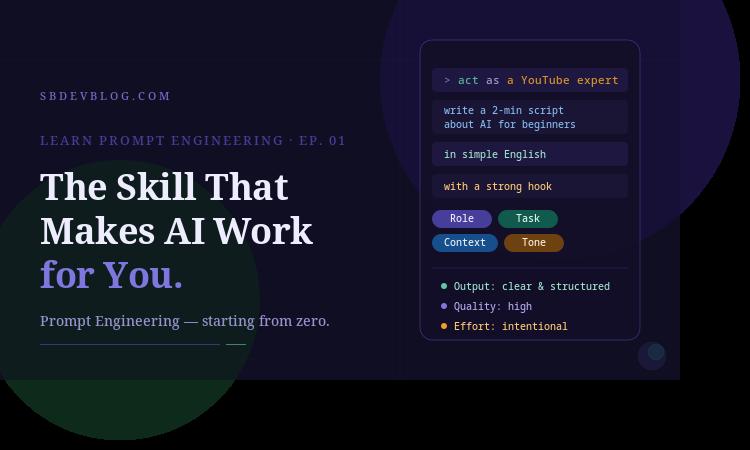
“Act as a YouTube expert. Write a 2-minute script about AI for beginners in simple English with a strong hook.”
Notice what’s happening there: you’ve given the AI a role (YouTube expert), a task (write a script), context (about AI, for beginners), and an output format (2-minute, simple English, strong hook). That’s all it takes to go from generic to genuinely useful.
Who benefits from learning this?
💻 Developers
Generate code faster, debug efficiently, automate boilerplate tasks, and build AI-powered tools.
✍️Content creators
Write scripts, create viral hooks, generate SEO content, and repurpose ideas at scale.
🚀 Business builders
Build AI tools, offer automation services, start freelancing, and launch products faster.
The biggest mistake beginners make
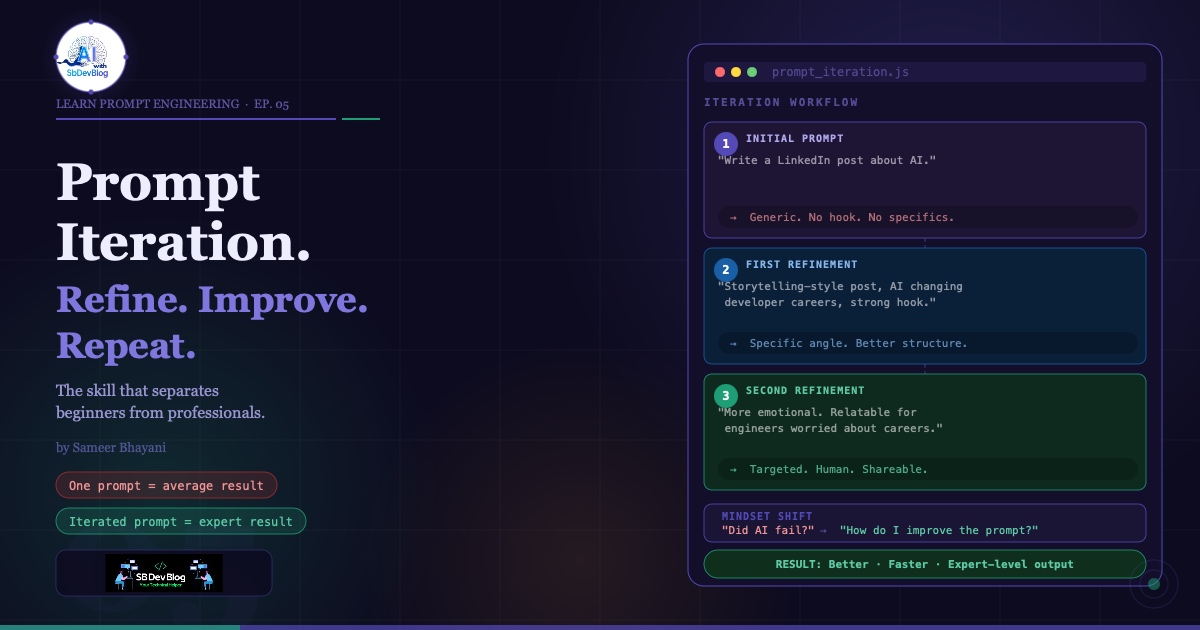
They write one prompt and stop. They get a mediocre result, shrug, and move on — or worse, decide AI isn’t for them.
Prompt engineering is iterative, just like coding. You write, you test, you improve, and you try again. The first output is a starting point, not a final answer. The best practitioners treat it like a conversation: they refine the instruction until the output is exactly what they needed.
Key takeaways from post
- A prompt is any instruction you give an AI — and clarity is everything
- Prompt engineering is the skill of getting consistently great outputs from AI
- Use the Role + Task + Context + Output Format structure to build strong prompts
- Good prompting is iterative — test, refine, and improve, just like writing code
- The people who master this won’t just use AI — they’ll direct i
Up next: The anatomy of a perfect prompt
In Post 02, we’ll break down exactly what goes into a high-performance prompt — with real examples you can steal.
FAQs: The Skill That Makes AI Actually Work for You
Prompt engineering is the skill of crafting clear, structured instructions to get the best possible output from an AI system. It involves thinking precisely, giving relevant context, assigning a role to the AI, and specifying the format of the output you want. Rather than simply asking a question, prompt engineering treats every AI interaction as a deliberate instruction design task.
A prompt is any instruction, question, or input you give to an AI model. Examples include ‘Write a poem,’ ‘Fix this code,’ or ‘Give me startup ideas.’ Every piece of text you send to an AI is a prompt. The quality of the prompt directly determines the quality of the AI’s response.
The same AI model can produce vastly different results depending on how it is prompted. A vague prompt like ‘Write about AI’ produces generic, unfocused output. A well-engineered prompt with a defined role, task, context, and output format produces clear, structured, and useful results. Mastering prompt engineering means you consistently get high-quality output without wasted effort or repeated attempts.
A bad prompt is vague, lacks context, and gives the AI nothing to anchor on — for example, ‘Write something about AI.’ A good prompt specifies who the AI should act as, what it should produce, the context it needs, and the format of the output — for example, ‘Act as an AI expert and explain prompt engineering in simple English with real-life examples in under 200 words.’ The difference in output quality is significant.
A reliable prompt structure has four components: Role (tell the AI who to act as), Task (what you want it to produce), Context (background information about the topic, audience, or constraints), and Output Format (how the response should be structured — bullet points, word count, tone, etc.). For example: ‘Act as a YouTube expert. Write a 2-minute script about AI for beginners in simple English with a strong hook.’
Anyone who uses AI tools regularly benefits from learning prompt engineering. Developers can generate and debug code faster. Content creators can produce scripts, hooks, and SEO content more efficiently. Business builders can use it to build AI-powered tools, automate workflows, and offer freelancing services. In short, anyone who wants to use AI effectively and consistently should learn this skill.
No. Prompt engineering does not require programming knowledge or a technical background. It is fundamentally a communication and thinking skill — the ability to express instructions clearly, provide the right context, and iterate on results. Anyone who can write clearly can learn and benefit from prompt engineering.
Large Language Models (LLMs) work by reading your input text, recognizing patterns across billions of training examples, and generating the most statistically likely response. They do not understand intent the way humans do — they respond to what is written. This is why clarity and structure in your prompt directly influences the quality and relevance of the output.
The most common mistake is writing one prompt and stopping when the result is not ideal. Prompt engineering is iterative — you write a prompt, evaluate the output, refine the instruction, and try again. Treating it like a one-shot process leads to frustration. The best results come from progressively improving your prompt across multiple attempts.
Yes, absolutely. The same AI model will produce completely different outputs depending on how you prompt it. A minimal, vague prompt produces generic output. A detailed, structured prompt produces precise, useful output. This is why the quality of your prompt — not just the power of the AI — determines the value of the result.
‘Act as’ is a role-assignment instruction. It tells the AI to adopt the perspective, vocabulary, and expertise of a specific persona — such as a senior developer, a marketing strategist, or a YouTube scriptwriter. This primes the model to draw on domain-specific patterns and produce output consistent with that role, making responses more relevant and professional.
In practice, prompt engineering is used to generate code and documentation, write and rewrite marketing copy, draft business plans and reports, create educational content, automate repetitive tasks, build AI-powered applications, and conduct research. Any task that involves working with an AI model benefits from well-crafted prompts.
Yes. As AI tools become standard in most professional workflows, the ability to direct them effectively is increasingly in demand. Professionals who can consistently produce high-quality output from AI tools — through skilled prompting — work faster, produce better results, and stand out in their fields. It is considered one of the most practical skills to develop for the current era of AI adoption.
Learn Prompt Engineering is a structured series on sbdevblog.com that takes readers from zero knowledge to confident, practical use of prompt engineering. Starting with fundamentals like what a prompt is and why structure matters, the series progresses to real-world prompt templates, advanced techniques, and use-case-specific strategies for developers, content creators, and business builders.