Most people use AI the same way every session. They open a chat window, type a question, read the answer, and move on. The output is fine. Sometimes it is good. But it rarely feels like it was written by someone who truly understands their field, their audience, or their specific situation.
That is not an AI limitation. That is the absence of a persona. Advanced users do not ask AI to just answer. They tell AI who to be first. And that one instruction changes everything about what comes back.
Quick recap: the series so far
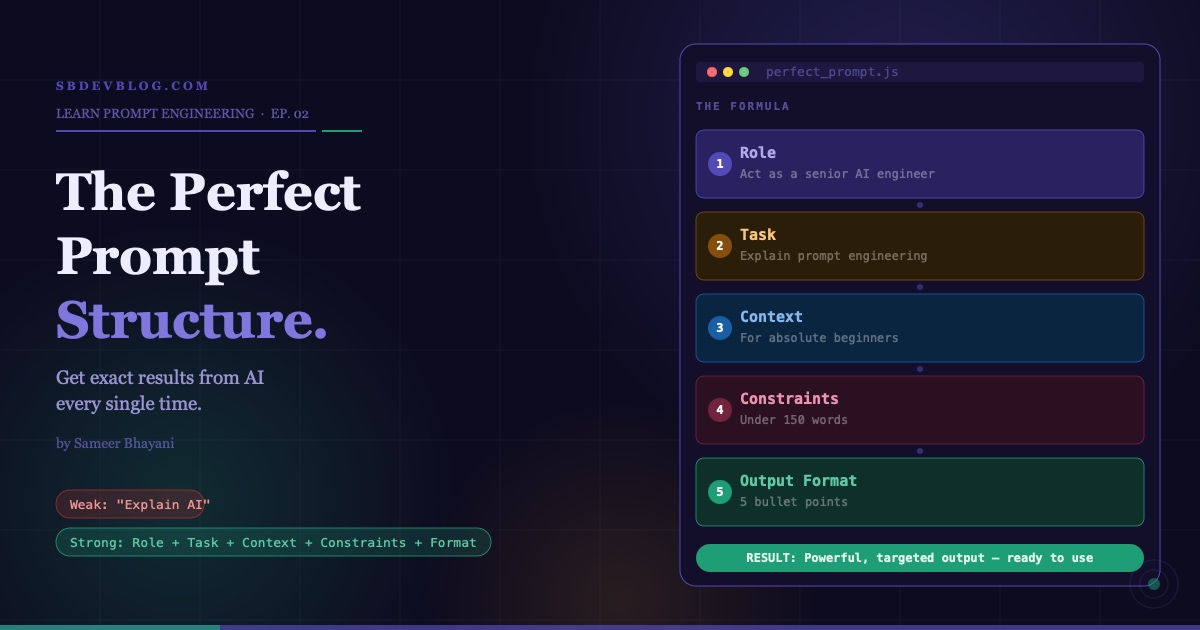
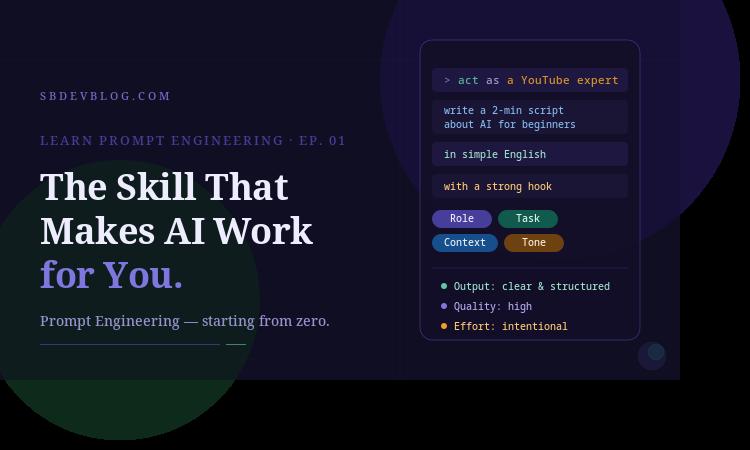
Here is where we stand in the Learn Prompt Engineering series on sbdevblog.com:
Everything we have covered so far gives you the structure, reasoning, and refinement skills to write strong prompts. Today we go a level deeper — into the identity layer that makes AI genuinely specialised.
What AI persona prompting actually is
Persona prompting means assigning the AI a specific role, expertise level, experience, tone, and personality before asking it to complete a task. Instead of asking a generic AI a generic question, you are priming the model to draw on a specific subset of its training — the patterns associated with a senior engineer, a marketing expert, a patient teacher, or whatever role you define.
The result is not just different wording. The response structure changes. The level of assumed knowledge changes. The examples used change. The tone, confidence, and framing of the output all shift to match the persona you assigned.
The difference a persona makes
Here is the simplest possible demonstration. Same topic, same AI, one with a persona assigned and one without:
The first prompt produces generic life advice that could apply to anyone. The second produces a targeted, field-specific roadmap that acknowledges where the person is coming from, what transferable skills they have, and what specific steps are realistic for their situation. The AI has not become smarter — it has been given context to apply its intelligence more precisely.
Four real-world personas and how they transform output
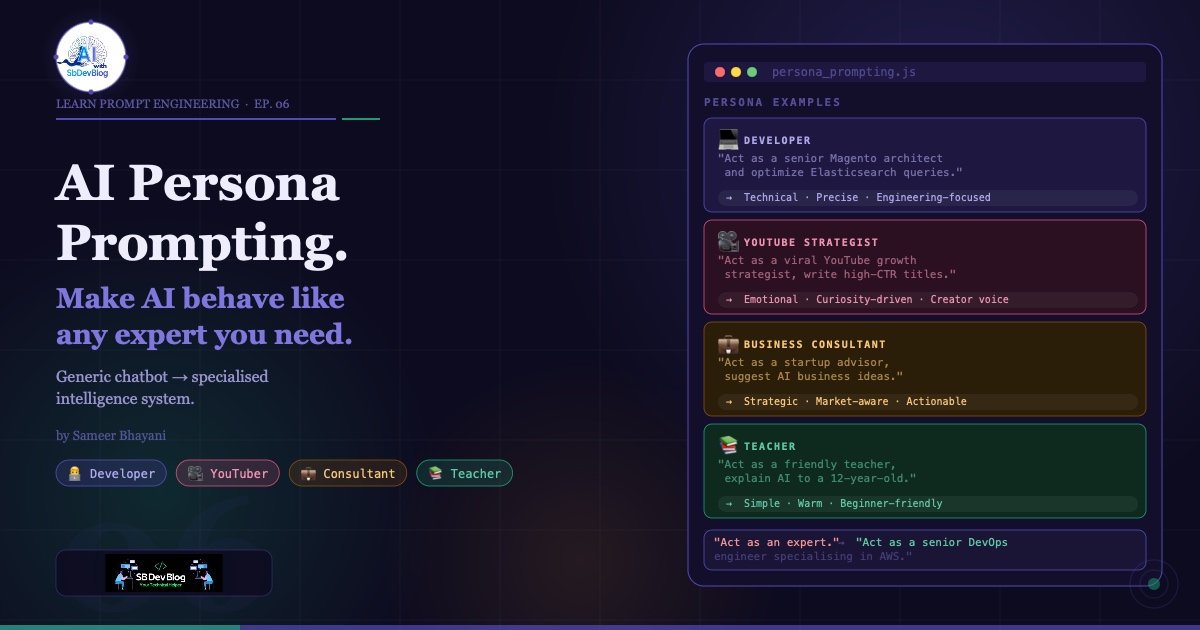
Let me walk you through four distinct persona examples, each producing a completely different type of output from the same underlying model:
Four prompts, four completely different response styles — all from the same AI. The persona is the instruction that tells the model which lens to apply to your request.
The anatomy of a strong persona prompt
A weak persona is vague. A strong persona is specific. Here are the four components that make a persona prompt genuinely effective:
Vague vs specific: the quality gap
The vague version gives AI nothing to work with. Expert in what? For whom? At what level? The specific version defines the lens so precisely that the model has clear guidance on every dimension of the response.
The pro move: combining persona with other techniques
Persona prompting becomes exponentially more powerful when layered with the techniques from earlier Posts. Here is what a fully combined expert-level prompt looks like:
Every layer adds precision. The persona defines who is answering. Chain of Thought ensures logical reasoning. Context grounds the output in the real situation. Output format makes it immediately usable. This is how professional AI workflows are built.
Building persistent AI workflows with personas
Once you understand persona prompting, a natural next step is to build dedicated AI assistants for the recurring tasks in your workflow. Instead of defining a persona from scratch every session, you create a reusable persona prompt that you deploy consistently.
This is where AI stops feeling like a chatbot and starts functioning like a real digital collaborator — one that understands your domain, adapts to your needs, and produces output at the level of the expert it is emulating.
The most common mistake with persona prompting
The single most widespread error is assigning a vague persona. “Act as an expert” tells the AI almost nothing. Expert in what field? At what level? For what audience? With what communication style?
The rule is simple: the more precisely you define the persona, the more precisely the AI can apply it. A persona with a role, a specialisation, an experience level, and a communication style gives the model everything it needs to produce genuinely differentiated output.
Your challenge for this post
What’s coming in Post 07
In the next Post we explore Prompt Chaining — the technique professionals use to connect multiple prompts into intelligent workflows, automation systems, and mini AI agents. Instead of treating each prompt as a standalone interaction, you design sequences where the output of one prompt becomes the input of the next. This is where AI starts operating less like a tool you query and more like a pipeline you architect. Do not miss it.
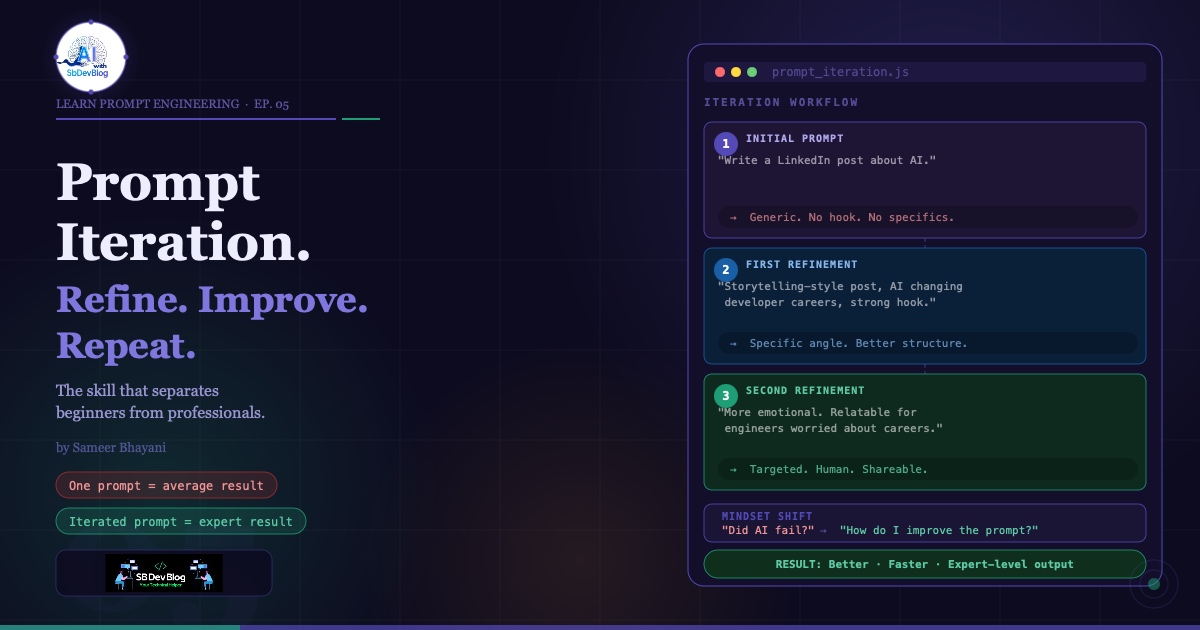
Prompt iteration is the practice of continuously improving your AI prompt based on the output you receive. Instead of writing one prompt and accepting the result, you evaluate the response, identify what is missing or off, and refine the instruction. Each iteration produces better output than the last. It is one of the most important skills in professional prompt engineering.
AI language models respond to the instructions they are given. A first prompt is rarely specific enough to capture everything the model needs — the right tone, audience, format, and context. Each response reveals what information was missing from the original instruction. Iterating on the prompt fills those gaps progressively, producing output that is far more accurate and useful than what any single prompt can achieve.
Start with a clear initial prompt and evaluate the response. Ask yourself what is generic, unclear, or off-target about the output. Then add a single refinement — a change in tone, an added constraint, more specific context, or a different format instruction. Send the refined prompt and repeat the process. Three well-focused iterations typically transform an average response into expert-level output.
The most effective refinement commands are: “Make it shorter” or “Expand this section” for length control; “Make it more conversational” or “Sound more professional” for tone; “Explain simply” or “Use real examples” for clarity; and “Give 3 better versions” or “Rewrite with better clarity” for alternatives. These targeted instructions allow you to guide AI output precisely without rewriting your entire prompt from scratch.
A beginner treats a weak AI response as a failure and either accepts it or gives up. A professional treats a weak response as information — a signal about what the prompt was missing. Professionals iterate. They ask “how can I improve this prompt?” rather than “did AI fail me?” That single mindset shift, combined with the habit of iterating, is what separates average AI results from expert-level ones.
Yes — and this is one of the most powerful techniques in prompt engineering. You can ask AI directly: “What information is missing from my prompt to give a better answer?”, “What assumptions did you make to answer this?”, or “How could I rewrite this prompt to get a more useful result?” These questions turn AI into a collaborative thinking partner that actively helps you write better instructions.
Prompt iteration is most valuable for content creation, coding, debugging, business planning, resume writing, and automation workflows — any task where quality, tone, and specificity matter. Use it whenever the first AI response is technically acceptable but not quite right. For simple factual queries, a single prompt is usually sufficient. For anything that requires precision, style, or nuance, always iterate.
Q8. What does “AI is conversational” mean in practice?
It means AI is designed to be guided through a back-and-forth exchange, not used as a one-shot query tool like a search engine. Each message you send builds on the previous context. You can say “make it shorter,” “add more emotion,” or “explain simply” and the AI adapts instantly within the same conversation. This conversational nature is what makes prompt iteration so effective — the model retains context and improves with each instruction.
Prompt engineering is the skill of designing AI instructions that consistently produce high-quality, targeted output. It includes techniques like role assignment, structured formatting, few-shot examples, Chain of Thought reasoning, and prompt iteration. It requires no technical background and is one of the most practical skills for anyone using AI tools in their professional or creative work. The full Learn Prompt Engineering series is available on sbdevblog.com.