There is a moment every serious AI user hits. You’ve got the basics down. You know how to structure a prompt. You’ve tried few-shot prompting. And yet, for the harder problems — the ones that require real reasoning — the AI still stumbles. It jumps to an answer too fast. It skips steps. It confidently gets things wrong.
That is where your prompting strategy matters. Chain of Thought prompting can make complex tasks clearer and easier to check.
Quick recap: the series so far
Before we go deeper, here’s where we are in the Learn Prompt Engineering series on sbdevblog.com:
Each episode builds on the last. If you’ve followed along, you already know how to write structured, example-driven prompts. Today we add the ingredient that unlocks reasoning.
Why AI sometimes gets things wrong
Large Language Models generate responses from learned patterns. For simple questions this often works brilliantly. But on multi-step logic, debugging, planning, or decision-making tasks, a model can jump to a plausible answer without clearly checking each assumption. The output may sound confident and still miss an important dependency or constraint.
Where normal prompting starts failing
You’ll feel this breakdown on tasks like logical reasoning puzzles, code debugging with multiple potential causes, business planning with competing variables, and step-by-step mathematical problems. The more steps required to reach a correct answer, the more likely a standard prompt is to produce a plausible-but-wrong one.
What Chain of Thought prompting actually is
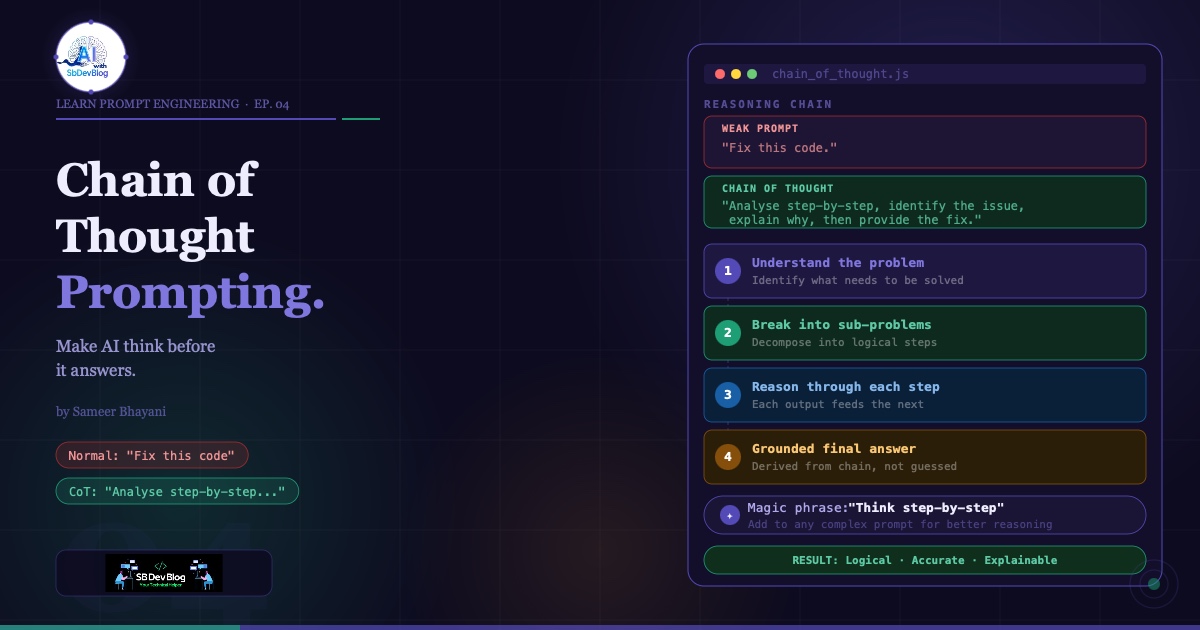
The concept is disarmingly simple. Instead of asking AI for an answer only, you ask it to break the task into clear steps and give a concise rationale before the conclusion. This structure is useful for logic, analysis, and sequential tasks because it exposes assumptions and makes the result easier to review.
A simple instruction that improves structure
Seeing the difference: before and after
Example 1 — YouTube channel strategy
You get a generic bullet list. Research your niche. Be consistent. Post quality content. Technically correct and completely useless to anyone who needs an actual plan.
Now the AI builds a logical sequence: audience research first, then niche selection, then channel setup, then content planning, then thumbnail and title strategy, then consistency systems, then monetisation milestones. Each step informs the next. The output is structured, logical, and actually actionable.
Example 2 — Code debugging
The second prompt turns the AI into something closer to a senior engineer doing a proper code review — not a junior developer who patches the first thing they spot. It identifies the root cause, explains the reasoning, and only then provides the fix.
How Chain of Thought works inside the model
When you ask an AI to work step by step, you are asking for a structured path from problem to answer. The model can surface assumptions, sub-problems, checks, and a final conclusion in an order that you can review and refine.
Where to use Chain of Thought prompting
The pro move: combining everything you’ve learned
Here’s where the series comes together. Chain of Thought is most powerful when combined with the structure from Episodes 01 through 03. Take everything you know and build it into one prompt:
Each component reinforces the others. A defined role sets the voice, while the step-by-step instruction structures the analysis. Context keeps the response grounded, and a clear output format makes the result immediately usable. Together, these elements create a more effective prompt.
The one mistake to avoid
Your challenge for this episode
What’s coming in Episode 05
Next up is one of the most immediately practical techniques in this series: AI Personas and Role Prompting Mastery. You’ll learn how to make AI behave like a senior developer, a marketing strategist, a YouTube consultant, or your own personal assistant — consistently, across every session. Once you understand how personas work at a deep level, AI stops being a generic tool and becomes a customisable intelligence system you design for your exact needs.
Q1. What is Chain of Thought prompting?
Chain of Thought prompting is a technique where you instruct an AI to reason through a problem step by step before arriving at a final answer. Instead of asking for a direct response, you ask the model to show its reasoning process. This significantly improves accuracy on complex tasks like logical reasoning, code debugging, mathematical problems, and multi-step planning.
Q2. How do I use Chain of Thought prompting?
The simplest way is to add the phrase “think step-by-step” to your prompt. For example, instead of “What’s the best marketing strategy for my business?”, write “Think step-by-step and explain the best marketing strategy for a new online business targeting beginners.” This instructs the AI to reason sequentially rather than jumping to a conclusion.
Large Language Models generate text by predicting likely next tokens. Without step-by-step guidance, the model can shortcut to a plausible-looking answer without proper reasoning. Chain of Thought forces intermediate reasoning steps, with each step providing context for the next. This builds a logical chain that produces more accurate and grounded conclusions.
Use Chain of Thought prompting for complex tasks that require sequential reasoning — debugging code, creating business plans, solving logic problems, planning multi-step projects, making structured decisions, and explaining concepts in depth. For simple, straightforward tasks, a standard structured prompt is sufficient and faster.
Normal prompting asks the AI for a direct answer, which works well for simple factual questions. Chain of Thought prompting asks the AI to reason through the problem step by step before answering, which works far better for complex problems. The key difference is that Chain of Thought activates sequential reasoning rather than pattern-matched responses.
Yes — and this is where it becomes most powerful. Combining Chain of Thought with role prompting, contextual information, and output format instructions produces expert-level results. For example: “Act as an AI business consultant. Think step-by-step and create a beginner roadmap for starting an AI agency. Structure the answer in bullet points.” This stacks role, reasoning, context, and format into one highly effective prompt.
It significantly improves output for complex, multi-step problems. For very simple questions or creative tasks that don’t require logical reasoning, it may not make a noticeable difference. The technique is most valuable when the quality of reasoning directly affects the quality of the answer — such as in debugging, planning, analysis, and problem-solving.
Prompt engineering is the skill of designing AI instructions that consistently produce high-quality, targeted output. It involves techniques like role assignment, structured formatting, providing examples through few-shot prompting, and Chain of Thought reasoning. It requires no technical background and is one of the most practical skills for anyone using AI tools professionally.
Q9. What is Role Prompting Mastery?
Role Prompting Mastery is the advanced practice of assigning detailed, specific personas to AI models so they consistently behave like a particular type of expert — such as a senior developer, marketing strategist, or business consultant. It goes beyond simple “act as” instructions to build persistent, customisable AI personas suited to specific workflows. It is covered in Episode 05 of the Learn Prompt Engineering series on sbdevblog.com.