I want to challenge a belief that holds most AI users back. The idea that a great prompt is something you write once, perfectly, and the AI just delivers. That’s not how professionals use AI. That’s not how expert prompt engineers work. And it’s almost certainly not how you’ll get the best results either.
The truth is that prompt engineering is less like filling out a form and more like having a conversation with a smart colleague. You start somewhere, you respond to what comes back, you refine, and you guide. That iterative process — not the perfect opening prompt — is where the magic happens.
Quick recap: the series so far
If this is your first time here, here’s the foundation we’ve built across this series on sbdevblog.com:
Everything we’ve covered so far gives you the tools to write strong opening prompts. Today we cover what happens next — and why “what happens next” is where the real results live.
Why most people quit too early
Here’s a scenario that plays out hundreds of times a day. Someone opens ChatGPT or Claude, types “Write a YouTube title about AI,” and gets back something like “Introduction to Artificial Intelligence.” Boring. Generic. Zero clicks.
They close the tab thinking AI is overhyped. But they didn’t fail because AI failed them. They failed because they stopped at the first attempt.
What experts do instead
Instead of quitting, an expert iterates. They take that weak output and immediately ask: what’s missing from this prompt? What context didn’t I give? What constraint would sharpen this? What example would show the AI what I actually want?
Same topic. Completely different instruction quality. And the output gap between those two prompts is enormous.
What prompt iteration actually means
Prompt iteration is the practice of continuously improving your prompt based on the output you receive. It’s a feedback loop. You prompt, you evaluate, you refine, you prompt again. Each cycle produces better output than the last.
This isn’t a workaround for bad AI. It’s the intended workflow. Large Language Models are designed to be guided through conversation. The more focused feedback you give, the more precisely the model can serve your actual goal.
A real-world iteration workflow
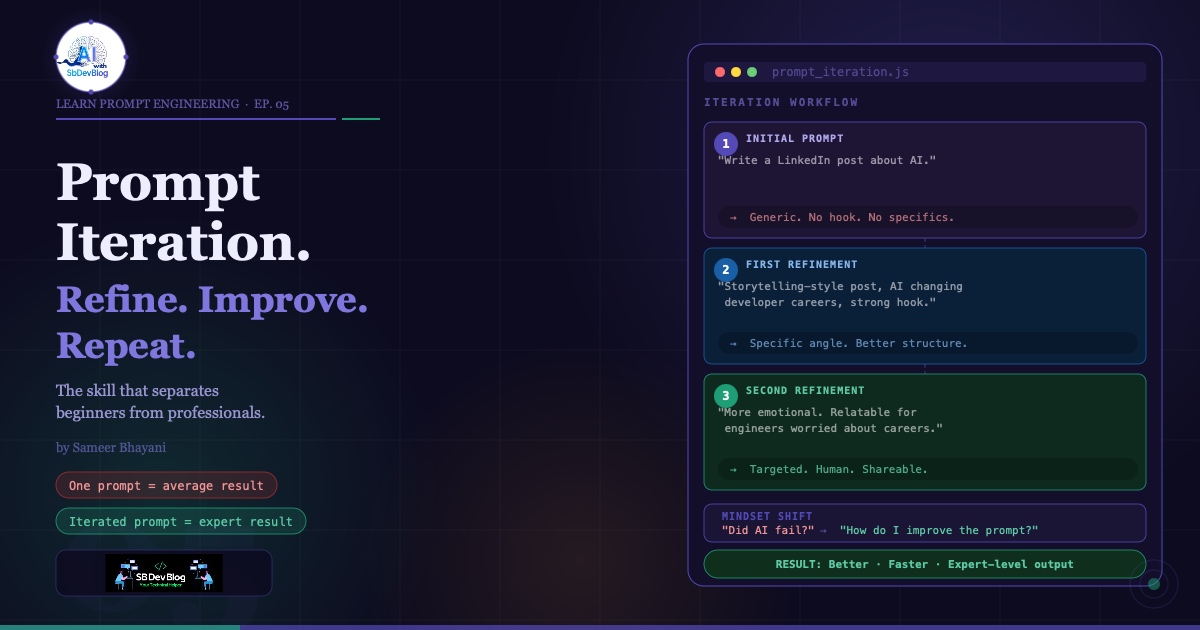
Let me walk you through exactly how this works in practice, using a LinkedIn post as the example. Three iterations, three distinct improvements:
Three prompts. Three minutes. A completely transformed output. This is not a special technique reserved for experts — it is simply the discipline of not stopping at the first result.
The mindset shift that changes everything
The single most important mental shift in prompt engineering is this:
Treats weak output as a failure. Closes the tab. Tries a different tool. Gets the same results.
Treats weak output as information. Identifies what’s missing. Refines and continues.
That one reframe — from judgment to curiosity — is what separates people who get average results from people who get extraordinary ones. The AI hasn’t changed. The approach has.
Powerful refinement commands you can use immediately
You don’t need to rewrite your entire prompt every time. Often a single well-chosen instruction transforms the output. Here are the most effective refinement commands:
“Expand this section”
“Summarise in 3 lines”
“Sound more professional”
“Add more emotion”
“Use real examples”
“Rewrite with better clarity”
“Show me an alternative approach”
“Improve this”
Where prompt iteration works best
The advanced move: ask AI what’s missing
Here is a technique that most users never discover, and once you use it you’ll reach for it constantly. When you’re not sure why the output isn’t quite right, ask the AI directly:
These commands turn AI into a collaborative thinking partner. Instead of guessing why the output missed the mark, you ask the model to diagnose the prompt itself. The feedback is almost always immediately actionable — and it teaches you to write better prompts at the same time.
The common mistake: chasing perfection from the start
The most widespread misconception in prompt engineering is that the goal is to write a perfect prompt on the first attempt. Even experienced prompt engineers don’t do this. Professional AI workflows always involve iteration.
You don’t need perfection. You need direction and refinement. Start with a clear intent, see what comes back, and guide from there. The conversation is the workflow.
Your challenge for this episode
What’s coming in Episode 06
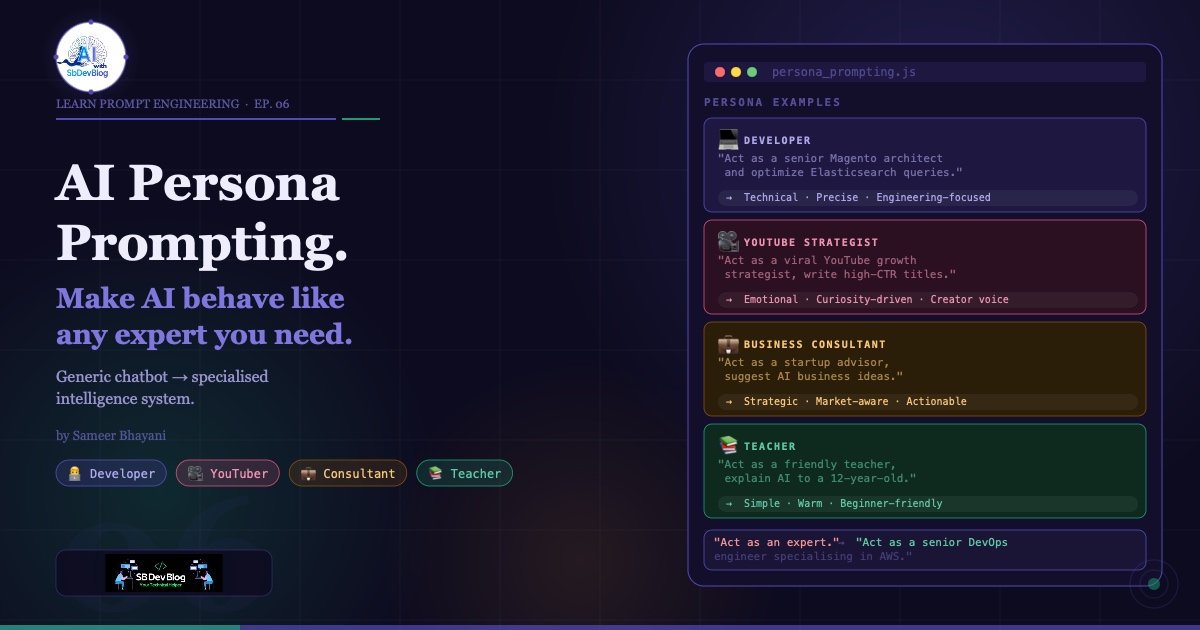
In the next episode we dive into AI Persona Prompting — one of the most immediately practical techniques in this series. You’ll learn how to make AI consistently behave like a senior developer, a YouTube strategist, a business consultant, or your own personal mentor. Once you understand how personas work at a deep level, AI stops being a generic chatbot and becomes a customisable intelligence system you design for your exact workflow.
rompt iteration is the practice of continuously improving your AI prompt based on the output you receive. Instead of writing one prompt and accepting the result, you evaluate the response, identify what is missing or off, and refine the instruction. Each iteration produces better output than the last. It is one of the most important skills in professional prompt engineering.
AI language models respond to the instructions they are given. A first prompt is rarely specific enough to capture everything the model needs — the right tone, audience, format, and context. Each response reveals what information was missing from the original instruction. Iterating on the prompt fills those gaps progressively, producing output that is far more accurate and useful than what any single prompt can achieve.
Start with a clear initial prompt and evaluate the response. Ask yourself what is generic, unclear, or off-target about the output. Then add a single refinement — a change in tone, an added constraint, more specific context, or a different format instruction. Send the refined prompt and repeat the process. Three well-focused iterations typically transform an average response into expert-level output.
The most effective refinement commands are: “Make it shorter” or “Expand this section” for length control; “Make it more conversational” or “Sound more professional” for tone; “Explain simply” or “Use real examples” for clarity; and “Give 3 better versions” or “Rewrite with better clarity” for alternatives. These targeted instructions allow you to guide AI output precisely without rewriting your entire prompt from scratch.
A beginner treats a weak AI response as a failure and either accepts it or gives up. A professional treats a weak response as information — a signal about what the prompt was missing. Professionals iterate. They ask “how can I improve this prompt?” rather than “did AI fail me?” That single mindset shift, combined with the habit of iterating, is what separates average AI results from expert-level ones.
Yes — and this is one of the most powerful techniques in prompt engineering. You can ask AI directly: “What information is missing from my prompt to give a better answer?”, “What assumptions did you make to answer this?”, or “How could I rewrite this prompt to get a more useful result?” These questions turn AI into a collaborative thinking partner that actively helps you write better instructions.
Prompt iteration is most valuable for content creation, coding, debugging, business planning, resume writing, and automation workflows — any task where quality, tone, and specificity matter. Use it whenever the first AI response is technically acceptable but not quite right. For simple factual queries, a single prompt is usually sufficient. For anything that requires precision, style, or nuance, always iterate.
It means AI is designed to be guided through a back-and-forth exchange, not used as a one-shot query tool like a search engine. Each message you send builds on the previous context. You can say “make it shorter,” “add more emotion,” or “explain simply” and the AI adapts instantly within the same conversation. This conversational nature is what makes prompt iteration so effective — the model retains context and improves with each instruction.
rompt engineering is the skill of designing AI instructions that consistently produce high-quality, targeted output. It includes techniques like role assignment, structured formatting, few-shot examples, Chain of Thought reasoning, and prompt iteration. It requires no technical background and is one of the most practical skills for anyone using AI tools in their professional or creative work. The full Learn Prompt Engineering series is available on sbdevblog.com.